

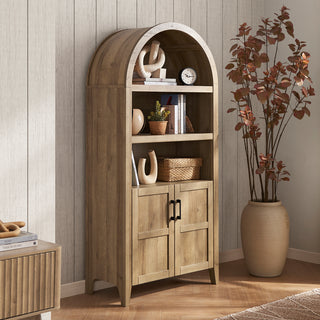





That wall in your home is the highest-value real estate in your place, yet it is doing absolutely nothing. Maybe there's a leaning bookshelf. Maybe there's a TV on a console two sizes too small, with a basket of cables underneath pretending to be decor.

The short version, because you're probably reading this while looking at the wall in question. A modular storage wall is two or more matching cabinets lined up across a wall, stacked with hutches and styled so the seams disappear, so the whole run reads as one built-in unit. No contractor, no permanent changes, and it comes with you when you move.
Here’s three decisions to make it work:
1. Know how much wall you are filling
You only need to do this once, and you need to do it before you order anything.

- Measure your usable wall width. Not the full wall. The part you can actually fill, measured between whatever's in the way: a door frame, a radiator, a light switch you need to reach. This single number decides your entire configuration.
- Then check your clearance. Measure from the wall to the nearest obstacle, your sofa, the coffee table, the path to the kitchen. Storage cabinets run around 15 to 16 inches deep, so leave at least 30 inches of walking room in front and the room will feel more open, not less.
- Take a glance at your ceiling height if you're planning to stack. Standard 8-foot ceilings comfortably take a base cabinet plus a hutch with room to breathe above it. Anything higher and you have the option of going taller, 72-77 inches is the sweet spot that can make your storage wall feel architectural.
Write those numbers in your phone. That's the whole measuring job, and it's the last time you'll need a tape measure.
2. Decide what mix of storage you actually need
Think about what kind of clutter you need to store, because the answer sorts into three piles.

-
Closed storage is for the stuff that has no business being seen. Cables, board games, paperwork, the spare charger graveyard, seasonal things. Solid doors, and you want more of this than you think
Products: Blake, Brooklyn, Norwin, Retrovie Collection -
Open storage is for the stuff you actually like looking at. Books, records, ceramics, the plant that's doing well. Open shelving keeps a storage wall from reading as a filing cabinet.
Products: Blake, Brooklyn, Norwin, Retrovie Collection -
Acrylic display is the in-between. It shows off what you want shown while keeping dust off it, which is why display cabinets are having a moment right now.
Products: Blake Collection
Choose the type of storage that works for you and the stuff you’ll be storing.
Tip: Ask yourself if the TV will be part of this wall. If it is, center it and build outward symmetrically. A modular entertainment center is designed for exactly that, with the TV framed in the middle and taller cabinets flanking it so the eye travels up instead of across. If the TV lives somewhere else, your center of gravity is whatever you most want people to look at. There’s more wall to fill up, no restrictions.

3. Choose how you want to stack it
That's the real promise of a modular system: you're not locked into someone else's floor plan. Every module ships in its own box so you can decide the shape of the whole — start with one piece, add a second when you need it, go wide or go tall, and change your mind later without starting over.
Use this easy guide as a starting point for your first configuration:
- Build your center piece first and set it against the wall.
- Build and add outward in both directions, seating each cabinet flush against the last. Cabinets should touch, because any daylight between two units breaks the built-in illusion.
- Grow upward, not just outward. Stack your hutches once the bases are set and aligned, lining the fronts up with the cabinets below. Position it to suit your system.
- Anchor anything tall, for safety and the peace of mind. The screws are small and easily patches up at move-out
Then style it like you meant it. You've built storage — and built it to grow. Now make it look deliberate.

The best part: it moves
Here's what a modular wall does that a built-in never will.
You don't have to build the whole thing at once. Buy one cabinet. Live with it. Add a hutch when you're ready, a second cabinet after that, the glass display whenever it feels right. The wall grows at whatever pace your budget does. And when you move, it moves.
Modules unstack, reconfigure, and rebuild into whatever your next place needs. The wall that was a media center in your apartment becomes a pantry run, a home office, or a nursery wall in the next one. Same pieces, different life.
A built-in stays behind. This doesn't. That's the whole idea. Start here, shape later. Build your modular system here!